29 May 2026
Results of the hot commissioning of ELKEM’s robot for rare earth alloy recovery
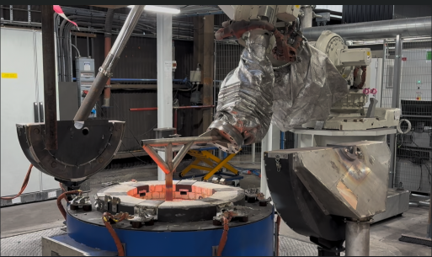
One of the innovations introduced in the high-temperature electrolysis (HTE) pilot to produce rare earth alloys (REA) is the improvement with respect to automation. In REEPRODUCE, ELKEM is responsible for the commissioning and continuous operation of the HTE cell, and the project has achieved an upgraded electrolysis cell compared to the one developed in the H2020 REE4EU project, which is more automated, and with special measures to attain a favourable working environment and increased throughput.
One particular labour-intensive step is the manual tapping of the produced REA. In order to address this, ELKEM has developed a robot arm used for harvesting the produced alloy during the electrolysis process. The robot arm handling concept was selected due to its compatibility with standard industrial robots, which function as reliable off-the-shelf components. Using an established robotic platform reduces the integration complexity and ensures access to proven control systems and predictable motion accuracy. To operate in the HTE cell environment, a custom high-temperature tool was developed. Both the gripping tool and the receiver which collects the REA must be able to tolerate severe thermal and chemical stress and exposure while maintaining the tight tolerances required for a repeatable engagement and safe retrieval.
In practice, the robot moves to the receiver location where the REA is collected and initiates the gripping sequence. Once the receiver is secured, it is lifted, and a controlled amount of fluoride is discharged back into the bath to prevent spillage during transfer to the casting station. At the casting station, the molten metal is poured into moulds. This operation must be completed rapidly in order to avoid premature solidification. After casting, the used receiver is transported to the cleaning station, and a clean receiver is inserted into the cell to prepare for the next cycle. The primary safety challenge here is the coordination required between manual tasks and the robot arm. To mitigate this, strict access control, interlocks, and defined handoff procedures are kept in place to ensure safe interaction between personnel and the robot.
Hot commissioning was carried out by testing the system at maximum operating temperature without molten metal present. The objective was to verify that the robot could complete a full operational sequence with a cold tool operating against a hot furnace in air. This test served as a critical validation step before introducing the molten material. ELKEM reports successful performance of the robot system during the hot test, demonstrating stable motion control, correct sequencing, and reliable tool engagement under thermal load. With these results, the setup is confirmed ready to proceed to the electrolysis validation tests.
The hot commissioning results show that the design can offer a strong combination of safety, flexibility, and operational reliability. At the same time, a key challenge remains the cost and durability of the tool assembly. If the service life of these components proves shorter than expected, operational costs may increase significantly. Ensuring long-term reliability under extreme conditions, while preserving the precision needed for consistent coupling, remains the primary engineering concern moving forward.
Photo: Hot commissioning of ELKEM’s robot-assisted HTE setup, validating the handling sequence and tooling performance under maximum operating temperature before piloting.