06 Jul 2026
Policy recommendations for a rare earth permanent magnet recycling value chain in Europe
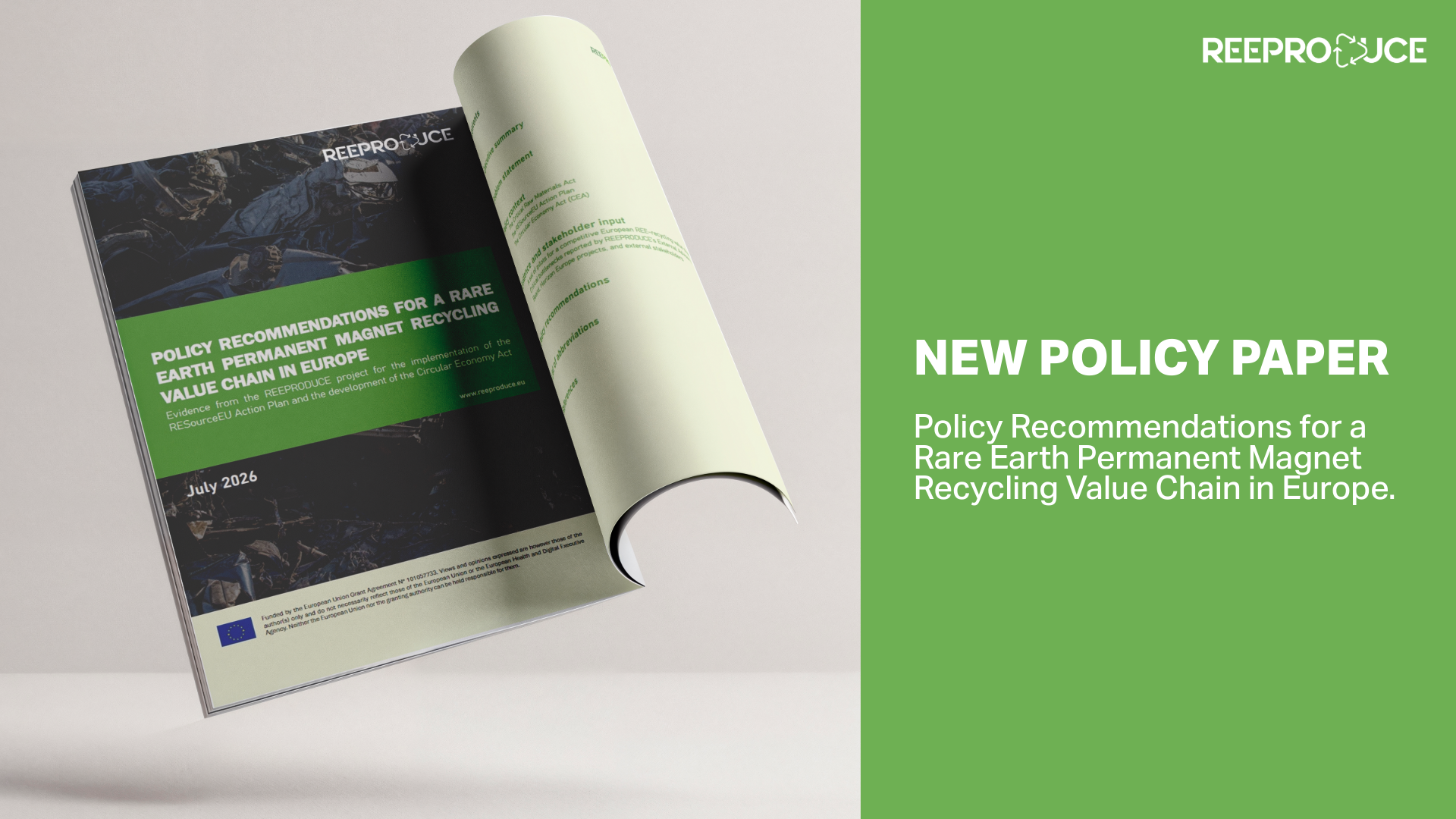
We are pleased to share our new policy paper “Policy Recommendations for a Rare Earth Permanent Magnet Recycling Value Chain in Europe“, which identifies persistent barriers preventing large-scale recycling of rare earth permanent magnets in Europe.
Europe’s transition to climate neutrality, digitalisation and strategic defence capabilities depends on secure access to rare earth permanent magnets. Yet the EU remains almost entirely dependent on imports for rare earth elements (REEs) and permanent magnets, with China controlling more than 90% of global supply chains. Recent export controls and trade restrictions have highlighted how vulnerable these supply chains remain, raising concerns for Europe’s industrial competitiveness and strategic resilience.
Demand for REEs and permanent magnets continues to grow, driven by the deployment of renewable energy and growing electrification. At the same time, there are currently no market-ready substitutes in Europe, and without changes to current recycling practices and capabilities, import dependency on China is likely to persist. Securing alternative sources of CRMs for European industry starts with recovering what is already embedded in products on the European market, but this cannot be achieved without resolving some practical barriers first.
EoL products represent a growing opportunity to reduce this dependency and the security of supply. Large volumes of rare earth magnets embedded in EoL products are already collected in Europe but rarely recovered. Recovery rates remain very low, largely limited to pre-consumer in-process waste, while valuable secondary resources are lost through shredding, export or downcycling.
However, Europe currently has no industrial recycling capacity for REEs, a gap that is primarily due to the absence of systems and obligations to consistently route Neodymium-based magnets from diverse EoL products into dedicated recycling processes. There are no mature and industrially proven technologies that can reliably identify if and where they are located inside different EoL products, nor technologies to sort and extract them in a cost-effective way, with minimal impurities. Moreover, the processes needed to recover and purify REEs from different magnet types – different chemistries, coatings and impurities – are not yet mature. Although technical knowledge already exists in Europe, these processes are not yet robust at scale. These barriers span the full recycling value chain and require coordinated responses at every stage. Addressing this would also deliver significant environmental benefits, not only in terms of toxic and radioactive waste, wastewater avoidance and overall reduction of GHG emissions related to primary production, but also would contribute significantly potential reduction of EoL landfilling.
Despite growing demand and increased policy attention through the Critical Raw Materials Act, the RESourceEU Action Plan and the forthcoming Circular Economy Act (CEA), the EU lacks an integrated value chain to recover REEs from EoL products at scale. Improving the identification, recovery and recycling of rare earth permanent magnets is therefore a critical issue for Europe’s industrial resilience and strategic autonomy.
The considerations presented in the policy paper draw on empirical evidence from the REEPRODUCE project, which is demonstrating at industrial pilot scale, a first sustainable and complete European REEs-recycling value chain of EoL products. The evidence is complemented by input from its External Advisory Board, external industry stakeholders, and EU-funded projects in the cluster hub “CRM4EU”. These responses were collected through a targeted survey, with the aim to reflect practical experience from projects and stakeholders working along the REE recycling value chain and understand which barriers they face in how they handle EoL products containing REEs.
Based on this evidence, the paper identifies persistent barriers preventing large-scale recycling of rare earth permanent magnets in Europe, and sets five policy recommendations to support the rollout of the RESourceEU Action Plan, the implementation of the CRMA and the development of the CEA:
1. Ensure labelling and digital products passport requirements deliver actionable data across the full rare earth recycling value chain.
2. Introduce short-term identification measures for EoL products already in the waste stream, to complement the long-term labelling requirements.
3. Establish operational requirements for the identification, separation, extraction and physical recovery of permanent magnets from EoL products.
4. Support the scale-up of European REE-recycling from pilot to industrial capacity.
5. Ensure coherent definitions, reporting requirements and recovery obligations across policy instruments.